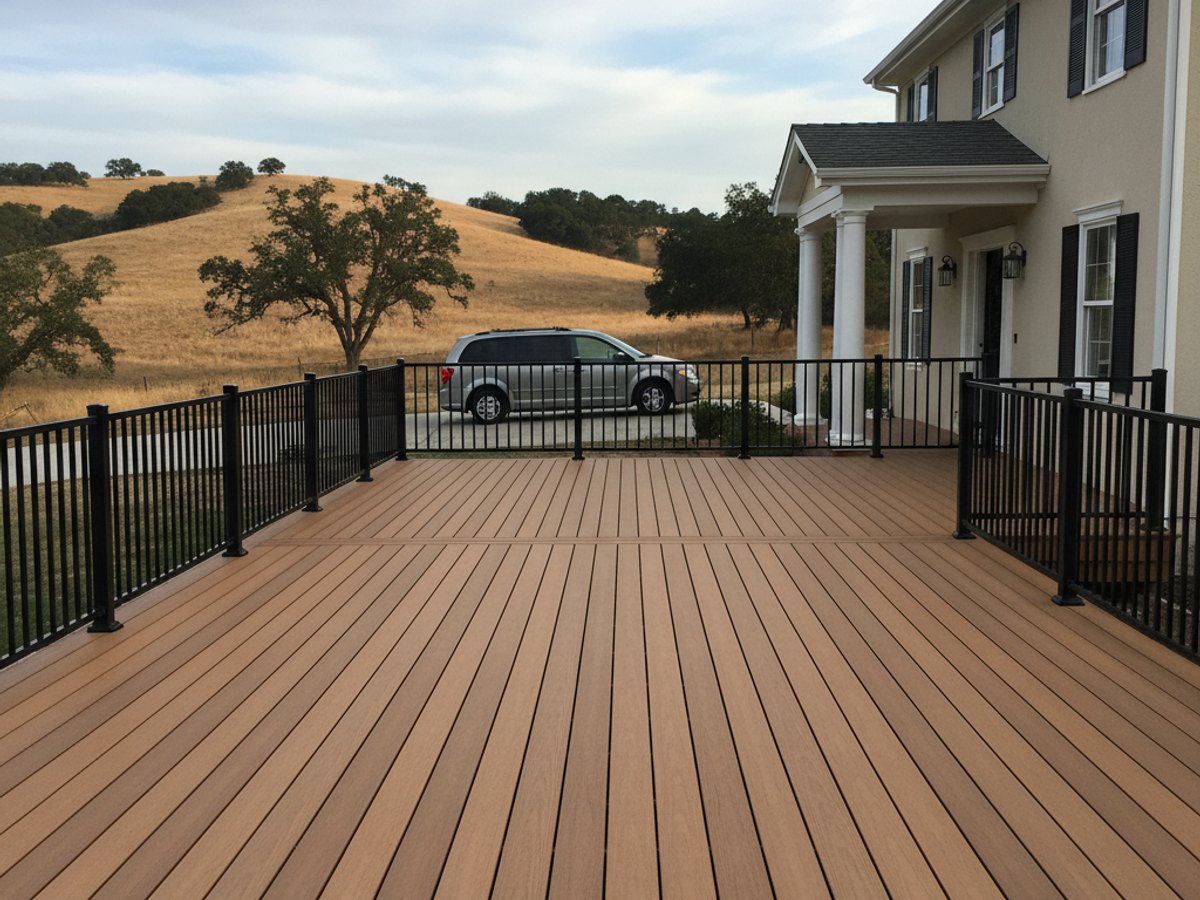
Lumber choice gets all the attention when people plan a deck. Redwood or composite, cable rail or wood pickets. What actually decides whether that deck is still level in eight years is what's under it, and in Fresno that's rarely simple dirt.
We dig a lot of post holes around this valley, and the ground fights back more than people expect. Here's what's actually going on down there.
The hardpan layer
A lot of Fresno soil sits on top of a hardpan layer, sometimes called a duripan, a cemented band of clay and minerals that forms maybe 18 to 36 inches down depending on where you are. It's not rock, but a hand auger bounces off it like it is. We've hit hardpan on jobs in Clovis and on the east side of Fresno that needed a powered auger or a digging bar just to get through 4 inches of it.
The reason it matters for a deck isn't just the labor. A footing that rests on top of hardpan instead of punching through it can actually be fine for bearing, hardpan is dense and doesn't compress much. The problem is drainage. Water doesn't pass through it, it sits on it. If your footing hole fills with rain water and then you pour concrete into standing water, you get a weak pour and a post that rocks in two years. We dig, we check what's at the bottom of the hole, and if it's holding water we deal with that before concrete ever goes in, not after.
Clay, shrink-swell, and what a dry summer does to it
Away from the hardpan, a good amount of Fresno's native soil has real clay content, the kind that swells when it's wet and shrinks hard when it dries out. We get almost no rain from May through September, and ground temperatures under a slab or near a footing can sit well above 100 degrees for weeks at a time. That soil shrinks and pulls away from whatever is sitting in it. Come November and December, the rain comes back and the same soil swells back up.
A footing poured too shallow, or one that isn't resting on compacted, stable material, can actually move with that cycle. Not dramatically, but a quarter inch here and a quarter inch there over a few years shows up as a deck that's no longer level, a post that's developed a lean, or a ledger board pulling away from the house. Standard footing depth here runs 12 to 18 inches below grade, and we want that footing bearing on soil that isn't going to keep moving seasonally, which sometimes means going deeper than the minimum just to get past the layer that's actively shrinking and swelling.
Where the water actually goes
Most residential lots in Fresno are flat, built flat on purpose because this used to be farmland and irrigation needs flat ground. Flat is fine until a storm hits a yard that's baked hard all summer. Clay-heavy soil that's dried out doesn't absorb water fast, it sheds it, so a decent December downpour can leave water sitting right at the base of your deck posts for a day or two instead of draining off.
We grade around footings so water moves away from the post, not toward it, and we'll set a footing a couple inches proud of grade rather than flush with it so the post base and any metal hardware aren't sitting in a puddle every winter. On older lots where the yard has settled unevenly over sixty or seventy years, that grading check matters even more, because water that used to run off now pools in a low spot nobody noticed until a deck went in on top of it.
Older neighborhoods versus newer subdivisions
What's already in the ground changes the job. In the Tower District, Fig Garden, and other neighborhoods built from the 1920s through the 1950s, we regularly find old footings, buried debris, sometimes old irrigation line or septic infrastructure that never got mapped. Digging a new footing eight feet from the house isn't always a clean hole, it can involve working around something nobody expected.
Newer subdivisions out in Clovis, Sanger, and north Fresno are usually built on old agricultural land that got graded and filled before construction. That fill is sometimes well compacted and sometimes not, and it's rarely consistent across one lot. We've had footing holes six feet apart hit completely different soil. That's part of why we dig test holes before committing to a footing layout rather than just measuring off a plan on paper.
Permits and the inspection that actually checks this
Most deck jobs in Fresno that involve a structure attached to the house, or anything over a certain height off grade, need a permit through the city or county building department depending on where the lot sits. The inspection that matters most for everything above is the footing inspection, which happens after the holes are dug and before concrete gets poured. The inspector is checking depth, diameter, and that the footing is bearing on solid, undisturbed soil, not loose fill or standing water. Skipping that step, or pouring before it's signed off, is the kind of shortcut that doesn't show up until the deck is already failing.
If you're in an HOA community, which is common in a lot of the newer Clovis and north Fresno developments, check their rules on deck height and setbacks before you get attached to a design, separate from whatever the city requires.
None of this is complicated once you know what the soil's doing. It just means the footings get more attention than the decking boards on top of them, even though nobody admires a footing. We've done this enough around the valley to know where the hardpan usually sits and where the clay is going to move, and that's most of what our deck builder work actually involves before a single board gets cut.